Medical information sheet for a parent: what to put on it, and where to keep it
By the ParentFile team · Updated · 9 min read
The short answer
A medical information sheet is one page with what a paramedic or ER nurse asks first: your parent's name and date of birth, allergies with the reaction, every current medication with its strength and directions as printed on the label, medical conditions, doctors and pharmacy, insurance, two emergency contacts, and where the healthcare proxy, advance directive and any POLST or DNR are kept, plus a "last checked" date. Leave off the Social Security number, bank details and codes. Keep it on the fridge, in a wallet and in the hospital bag, and update every copy after any medication change or hospital stay.
When a parent is taken to the ER, the first questions are almost always the same: What medications does she take? Any allergies? Who is her doctor? Is there a DNR? If the answers are in someone's head, or spread over a dozen pill bottles, they arrive late or wrong. A medical information sheet puts them on one page that anyone can hand over.
Below: what goes on it, what to leave off, where to keep it and how to keep it current, plus a printable checklist. For a blank form, use our free one-page ER sheet.
What a medical information sheet is (and isn't)
A medical information sheet is a single page with the facts emergency staff need in the first minutes. Many city fire departments publish their own version. The Pawtucket Fire Department in Rhode Island, for example, asks for contact details, past medical history, daily medications with dosages, and allergies, and tells residents to keep the sheet on the refrigerator or in a purse or wallet.
It is not a full medical record, a medication schedule for the week, or a legal document. It doesn't replace an advance directive, a healthcare power of attorney or a POLST. It tells people that those exist and where they are.
What to put on it: 9 sections
Fill the sheet in with the pill bottles, insurance cards and recent discharge papers in front of you, not from memory.
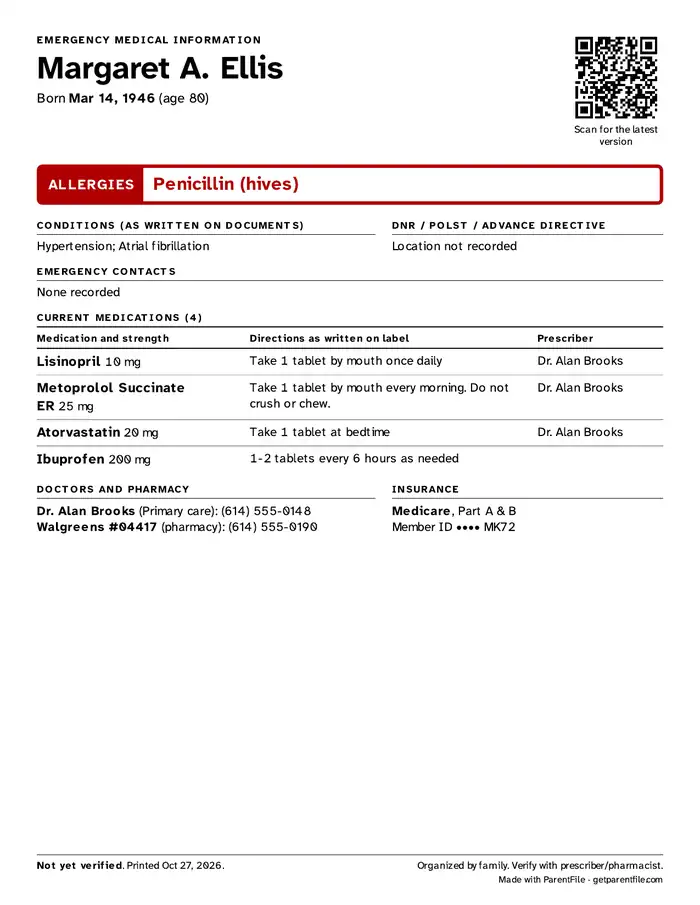
1. Identity
Full legal name (as on the insurance card), date of birth, home address, and the language your parent prefers to speak. If your parent has hearing loss, poor vision or memory problems, say so here. It changes how staff talk to them.
2. Allergies, with the reaction
Put allergies at the top, where a paramedic looks first. Write the reaction next to each one ("penicillin: hives", "codeine: vomiting"), because "allergic" covers everything from a mild side effect to a dangerous reaction. If there are no known allergies, write "No known allergies" rather than leaving it blank.
3. Current medications
The FDA's advice for a medication list applies here: include prescription medicines, over-the-counter drugs, vitamins and supplements, and for each one the name, strength, what it is for, and when, how and how much is taken. Copy the strength and directions exactly as printed on the label.
Common gaps: eye drops, inhalers, patches, injections, the daily aspirin, and anything from a second doctor. If your parent takes many medicines, keep the full list on a separate page and attach it. Our medication list guide covers that in detail.
4. Medical conditions
List diagnoses as they appear on doctor or hospital paperwork, for example "atrial fibrillation" or "type 2 diabetes, insulin". Add implanted devices (pacemaker, defibrillator, joint replacement) and major past surgeries with the year if you know it.
5. Doctors and pharmacy
Primary care doctor and any specialists, each with a phone number. Add the pharmacy name and phone number: when a medication list is uncertain, the pharmacy can often confirm what was filled.
6. Insurance
Carrier, plan name and member ID. If your parent has a Medicare Advantage plan, Medicare.gov says to use the plan's card for services instead of the red, white and blue Medicare card, so list the plan card. Note any drug plan or supplemental coverage too.
7. Emergency contacts
At least two people, with their relationship ("daughter", "neighbor with a key") and a mobile number. Put the person who usually goes to appointments first.
8. Where the important documents are
One line each: healthcare proxy or healthcare power of attorney, advance directive, POLST or DNR, HIPAA release. Write who holds the original and where it is ("POLST: original on the fridge under this sheet; copy with Dr. Patel"). Responders can't follow an order they can't find. Our guide to POLST vs DNR explains the difference between the two forms.
9. "Last checked" date
A date and the initials of whoever checked it against the bottles. Without it, nobody knows if the sheet is from last week or three years ago.
What NOT to put on the sheet
A sheet on the fridge can be read by anyone who comes into the kitchen: visitors, repair people, new aides. Leave off:
- Social Security number. It isn't needed in an emergency. The Medicare card carries a Medicare Number, which is not the Social Security number, and Medicare.gov says to share that number only with providers, insurers or health plans and trusted helpers such as a State Health Insurance Assistance Program (SHIP) counselor.
- Bank or card details, passwords, door or alarm codes.
- Long medical history. Keep it readable in one minute.
Where to keep it
- On the refrigerator. Many local fire departments and the Vial of Life and File of Life programs use the fridge because responders know to look there. Our Vial of Life and File of Life guide explains how those programs work.
- In a purse or wallet, as a folded copy, or as a smaller medical ID wallet card with the essentials.
- In the hospital bag, with the insurance cards and a list of what to bring. See what to bring to the ER.
- With each family member who might go to the ER, as a photo or a shared copy.
- On the phone. On an iPhone, Medical ID in the Health app can hold medications, allergies, conditions and emergency contacts. Apple says that with "Show When Locked" turned on, it can be viewed from the lock screen without the passcode, and that it can be shared automatically with emergency services when your parent calls or texts them, where available. Android phones have a similar emergency information feature.
In the UK, the Lions "Message in a Bottle" scheme works the same way, with a container in the fridge. See our UK checklist.
How to keep it accurate
The sheet is only useful if it is right. The FDA advises reviewing and updating a medication list often, especially after a new prescription, a dose change or stopping a medication. In practice:
- After every hospital stay or ER visit, compare the discharge medication list with the sheet. Medicines are often started, stopped or changed there.
- After every new prescription, update the sheet the same day.
- Every few months, take the sheet to the medicine cabinet and check it bottle by bottle.
- When you update one copy, update all of them: fridge, wallet, hospital bag, siblings' phones. An old copy in the bag is how a wrong list ends up in the ER.
If you're organizing more than this one page, our guide on how to organize your parent's medical information walks through the whole set.
Printable checklist
- Full name, date of birth, address, preferred language
- Hearing, vision or memory notes
- Allergies at the top, each with the reaction (or "No known allergies")
- Every medication: name, strength, directions as on the label, what it is for
- Over-the-counter medicines, vitamins, supplements, eye drops, inhalers, patches
- Medical conditions, devices, major surgeries
- Primary doctor, specialists, pharmacy, all with phone numbers
- Insurance carrier, plan and member ID (plan card if Medicare Advantage)
- Two emergency contacts with relationship and mobile number
- Where the healthcare proxy, advance directive, POLST/DNR and HIPAA release are kept
- No Social Security number, bank details, passwords or codes
- "Last checked" date and initials
- Copies: fridge, wallet, hospital bag, family members, phone medical ID
- Reminder set to recheck after any hospital stay and every few months
Where ParentFile fits
You can do all of this with a pen and our free sheet. ParentFile is an organization tool for families who want help keeping it current: you photograph the pill bottles and confirm each item, add allergies, conditions, doctors and insurance, and record in the documents map whether a document exists and where the original is kept. It prints the one-page ER sheet and wallet cards, and siblings can open a view-only link. It doesn't give medical advice, check interactions or recommend doses; every sheet says to verify with the prescriber or pharmacist.
Frequently asked questions
- What should be on a medical information sheet?
- The basics a paramedic or ER nurse asks for first: your parent's full name and date of birth, allergies and the reaction, every current medication with its strength and directions, medical conditions, doctors and pharmacy with phone numbers, insurance details, two emergency contacts, and where documents such as a healthcare proxy or POLST are kept. Add the date it was last checked.
- Where should my parent keep a medical information sheet?
- Where responders and family will find it. Many local fire departments and Vial of Life programs ask people to keep it on the refrigerator, and a copy in a purse or wallet. Keep another copy in the bag you would take to the hospital, and make sure family members know where it is.
- How often should a medical information sheet be updated?
- Whenever something changes: a new prescription, a dose change, a stopped medicine, a new diagnosis, a new doctor or a hospital stay. The FDA advises reviewing a medication list often and updating it after any change. A quick check every few months against the actual pill bottles catches what was missed.
- Should I put my parent's Social Security number on the sheet?
- No. A sheet on the fridge can be read by anyone who walks into the kitchen. The Medicare card has a Medicare Number that is not the Social Security number, and Medicare.gov says to share that number only with providers, insurers and trusted helpers. On the sheet, the insurance carrier and member ID are usually enough.
- Is a medical information sheet the same as a medical ID on a phone?
- No, but they work well together. A phone medical ID, such as Medical ID in the iPhone Health app, can show allergies, medications, conditions and emergency contacts on the lock screen. A paper sheet works when the phone is locked away, flat or left at home, and it can be handed to the ER staff.
Sources
- Create and Keep a Medication List for Your Health, U.S. Food and Drug Administration (FDA)
- Your Medicare card, Medicare.gov, Centers for Medicare & Medicaid Services
- Set up your Medical ID in the Health app on your iPhone, Apple Support
- Medical Information Sheet, Pawtucket Fire Department (City of Pawtucket, RI)
Sources checked on November 1, 2026. If you spot something out of date, email support@getparentfile.com.
Not medical or legal advice. ParentFile guides help families get organized. They don't replace a doctor, pharmacist, nurse or lawyer. In an emergency, call 911 (US) or 999 (UK).