Organizing medical records for an aging parent
By the ParentFile team · Updated · 9 min read
The short answer
Keep two layers: a dated one-page summary on top (conditions, current medications, allergies, doctors, insurance, emergency contacts and where the legal documents are) and the supporting records behind it in seven labeled sections. Gather what's already in the house first, then request missing records. Under HIPAA your parent can have copies sent to you, and providers must act within 30 days. Keep copies on the fridge, in the wallet, in the ER bag and on family phones, and update the summary after every hospital stay.
Most families start organizing a parent's medical records the same way: a hospital stay, a new diagnosis, or a doctor asking "what medications is she on?" while everyone looks at each other. The papers exist, but they are spread across a kitchen drawer, three patient portals, a pharmacy and your dad's memory.
This guide walks through a simple system: what to collect, how to get copies you don't have, how to arrange it so you can find anything in a minute, and how to keep it current without it becoming a second job. A printable checklist is at the end.
Start with the goal: two layers
When people ask how to organize medical records, they usually picture filing every page. You don't need that. You need two layers:
- A one-page summary on top. Conditions, current medications, allergies, doctors, insurance, emergency contacts, and where the legal documents are. This is the page you hand an ER nurse or a new specialist.
- The supporting records behind it. Visit summaries, discharge papers, test results, the vaccination record, insurance cards and copies of legal documents, in labeled sections.
The summary does most of the work. If you only finish one thing this week, make it that page. Our free one-page ER sheet is a ready template for it.
Step 1: Talk to your parent first
It is their information. Before you request anything, ask your parent:
- Who should be able to see their medical information, and who should not?
- Are they comfortable with you joining appointments or talking to their doctors?
- Have they signed a healthcare power of attorney, a HIPAA authorization or an advance directive? Where are the originals?
A short, calm conversation now avoids a hard one in a hospital hallway. If siblings are involved, agree on who keeps the master copy (see sharing parent care with siblings).
Step 2: Gather what's already in the house
Collect into one box or folder, without sorting yet:
- Pill bottles and any printed medication lists (for the full method, see how to make a medication list for an elderly parent)
- Medicare, Medicare Advantage, Medigap, Part D and any other insurance cards (photograph both sides)
- After-visit summaries and hospital discharge papers
- Letters with test results or new diagnoses
- Legal documents: healthcare power of attorney, HIPAA authorization, living will or advance directive, POLST or DNR (our important documents checklist lists them all)
- A list of every doctor, clinic, pharmacy and hospital they use
Most of what you need is usually already here. The gaps become your request list.
Step 3: Request the records you don't have
Under HIPAA, your parent has the right to get copies of their health information from doctors, hospitals and health plans, and to ask that copies be sent directly to someone else, such as a family member or caregiver (HHS, 2026 (opens in a new tab)). Key points:
- Timing. The provider must act on the request within 30 calendar days. It can take up to 30 more days only if it explains the delay in writing within the first 30 days and gives a date (HHS, 2026 (opens in a new tab)).
- Format. In most cases they can get the records in the format they ask for, including electronically, and many providers offer portal downloads.
- Fees. Providers may charge a reasonable fee for copies, and an unpaid medical bill is generally not a reason to refuse access.
If you are the personal representative. When a healthcare power of attorney is in effect, the person named is generally the patient's personal representative under HIPAA and has the same right of access as the patient (HHS, 2026 (opens in a new tab)). Some powers of attorney take effect only when the parent can no longer make their own decisions. Separate psychotherapy notes are not covered by the right of access for anyone.
If you are not. Your parent can sign the provider's release or authorization form naming you. Ask each provider for its own form; many accept a general HIPAA authorization, but not all do.
Medicare. With a Medicare account, your parent can download their Part A, B and D claims data, which is a useful list of who they have seen and which drugs were filled. If they have Medicare Advantage, the download shows only drug claims (Medicare.gov (opens in a new tab)). For you to speak with 1-800-MEDICARE on their behalf, your parent can complete form CMS-10106 (CMS, 2026 (opens in a new tab)).
Patient portals. Ask each practice about proxy access: your own login to your parent's portal, rather than using their password. Federal guidance encourages separate caregiver logins because sharing the patient's login exposes all their private messages (HealthIT.gov (opens in a new tab)).
Step 4: Write the one-page summary
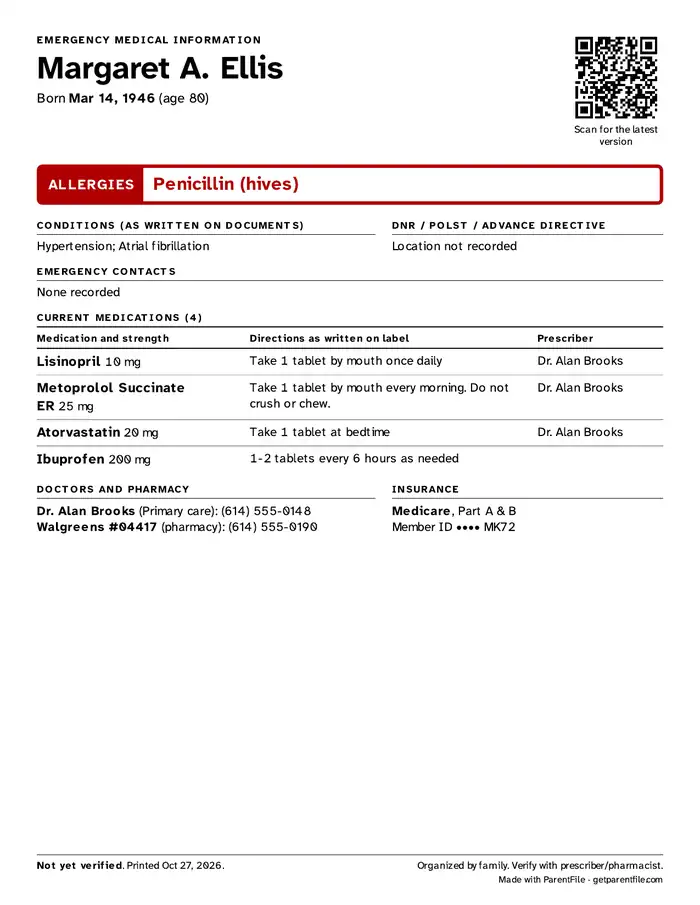
Now build the top layer. Keep it to one page so nobody has to search:
- Full name, date of birth, preferred language
- Diagnoses and conditions that a new doctor must know
- Current medications with dose and schedule (or "full list attached")
- Allergies and what happens (rash, swelling, breathing trouble)
- Primary doctor and key specialists, with phone numbers
- Preferred hospital and pharmacy
- Insurance: plan names and member IDs
- Emergency contacts, and who holds the healthcare power of attorney
- Where the advance directive and any POLST or DNR are kept
Date the page at the top. A summary without a date is a guess.
Step 5: Arrange the supporting records
Use the same sections on paper and in digital folders so everyone looks in the same place:
- Summary (the one page)
- Medications
- Doctors and appointments
- Hospital stays and discharge papers
- Test results and imaging reports
- Insurance
- Legal documents (copies; note where originals are)
A three-ring medical records binder with tabs works well for paper; see how to make a caregiver binder for a section-by-section setup. For digital, a shared folder with the same seven names, and file names that start with the date (2026-10-14 cardiology visit), keeps things sortable.
Keep it lean. Routine bills, old explanation-of-benefits letters and duplicate printouts make the file harder to use. Keep what a doctor might ask about.
Step 6: Make it reachable in an emergency
An organized file in a drawer in your house does not help when your parent is in an ambulance across the state. Plan where copies live:
- On the fridge, for paramedics: a fridge form such as the Vial of Life or File of Life. In the UK, the Message in a Bottle scheme does the same.
- In the wallet: a short medical ID card with conditions, allergies and contacts.
- In the ER bag: the summary plus insurance cards (what to bring to the ER).
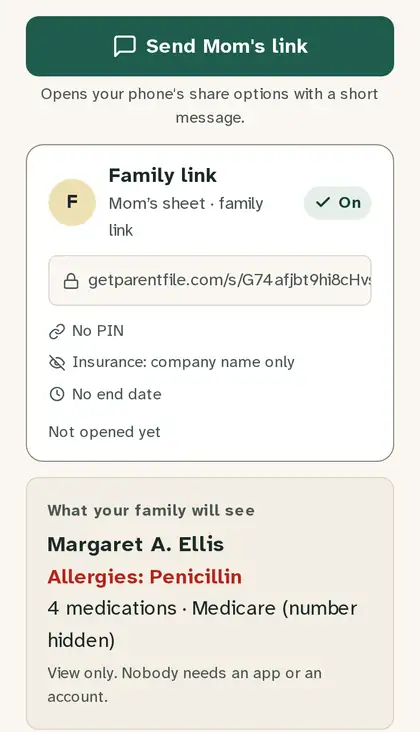
- On your phone and your siblings' phones: a current copy everyone can open.
Step 7: Keep it current
Records go stale fast. Medications change after almost every hospital stay, so update the summary the day your parent comes home (the hospital discharge checklist has the questions to ask). Then set a reminder every three months to check the medication list against the pill bottles and confirm doctors and contacts.
One person should own the master copy. Everyone else reads from it rather than keeping their own version.
Where ParentFile fits
Some families are happy with a binder and a shared folder. If you would rather not type it all, ParentFile is an organization tool for this job: you photograph pill bottles, insurance cards and discharge papers, it reads them, you confirm every item, and it produces the one-page ER sheet, wallet cards and a medication list that siblings can open through a view-only link. It does not give medical advice or check medications. The free ER sheet is a good place to start either way; see what the kit includes if you want the app.
Printable checklist: organizing a parent's medical records
- Talked with my parent about who can see their information
- Healthcare power of attorney: exists? where is the original?
- HIPAA authorization or provider release forms signed for the family member(s) who need access
- All pill bottles and medication lists collected
- Insurance cards photographed, front and back
- List of every doctor, clinic, pharmacy and hospital
- Missing records requested (date requested, date due: 30 days)
- Portal proxy access set up with each practice
- Medicare claims downloaded (if on Medicare)
- One-page summary written and dated
- Supporting records sorted into the seven sections
- Copies on the fridge, in the wallet, in the ER bag and on family phones
- Master copy owner agreed
- Next 3-month review date: ________
Frequently asked questions
- What is the best way to organize a parent's medical records?
- Keep two layers. A short summary on top (conditions, medications, allergies, doctors, insurance, emergency contacts and where the legal documents are) that fits on one page, and the full records behind it in labeled sections or folders. The summary is what you hand over in an emergency; the records are for appointments and questions.
- Can I get copies of my parent's medical records?
- Your parent can ask any doctor or hospital to send copies directly to you. If you are their personal representative under HIPAA, for example because a healthcare power of attorney is in effect, you have the same right of access they do. Otherwise providers usually need your parent's written permission.
- How long does a doctor have to send medical records?
- Under HIPAA, a provider must act on an access request within 30 calendar days. It can take up to 30 more days only if it tells you in writing, within the first 30 days, why it needs more time and when you will get the records.
- Should I keep my parent's medical records on paper or digitally?
- Both work. Paper is easy to grab and hand to an ER nurse; digital copies can be shared with siblings and survive a lost folder. Many families keep a printed one-page summary at home and a digital copy everyone in the family can open.
- What medical records should I keep for an elderly parent?
- The current medication list, recent visit summaries, hospital discharge papers, test results the doctor flagged, the vaccination record, insurance cards, and copies of the healthcare power of attorney, HIPAA authorization and any advance directive or POLST. Old bills and routine paperwork rarely need to be kept in the main file.
Sources
- Get it. Check it. Use it. Your right to access your health information, U.S. Department of Health and Human Services (HHS), Office for Civil Rights
- How timely must a covered entity be in responding to individuals' requests for access to their PHI?, HHS, Office for Civil Rights
- Does having a health care power of attorney (POA) allow access to the patient's medical and mental health records under HIPAA?, HHS, Office for Civil Rights
- Share your Medicare claims, Medicare.gov (CMS)
- CMS-10106: 1-800-MEDICARE Authorization to Disclose Personal Health Information, Centers for Medicare & Medicaid Services (CMS)
- Patient Engagement Playbook, Chapter 5: caregiver (proxy) access, HealthIT.gov (ASTP/ONC)
Sources checked on October 27, 2026. If you spot something out of date, email support@getparentfile.com.
Not medical or legal advice. ParentFile guides help families get organized. They don't replace a doctor, pharmacist, nurse or lawyer. In an emergency, call 911 (US) or 999 (UK).