Medical ID card for a parent: what to put on it
By the ParentFile team · Updated · 6 min read
The short answer
A medical ID card is a wallet-sized card with the health facts responders need if your parent can't speak for themselves: full name and date of birth, critical conditions, allergies, key medications (or where the full list is), one or two emergency contacts, their primary doctor, where documents such as a healthcare proxy or POLST are kept, and the date it was last updated. Leave off the Social Security number and full insurance numbers, and put the same information in the Medical ID on their phone.
If your mom or dad collapses at the grocery store, the people helping them have a few minutes and no history. A medical ID card in the wallet, next to the insurance card, gives paramedics and the ER team the facts your parent may not be able to say. This guide covers what to write on it, what to leave off, and how to put the same information on their phone.
What a medical ID card is (and isn't)
A medical ID card (also called an emergency medical card, medical alert card or "in case of emergency" card) is a wallet-sized card with the health facts someone would need if your parent couldn't speak for themselves.
It is different from:
- A medical alert bracelet or necklace. Engraved, worn on the body, room for only a few words.
- A Vial of Life or File of Life form. A longer form kept on the fridge at home. See our Vial of Life guide.
- A full medication list. The complete list, with doses and prescribers, belongs on a separate page. See how to make a medication list for an elderly parent.
The card is the version that travels with your parent. Ready.gov's emergency advice for older adults lists exactly this kind of information: a list of medicines with dosage instructions and any allergies, "need-to-know information for first responders," and contact information for important people and care providers.
What to put on a medical ID card
Keep it to what a stranger needs in the first ten minutes. Here is the order that reads fastest:
- Full name and date of birth. Exactly as on their insurance card, so the hospital can match records.
- Critical conditions. Things that change what a responder does: heart conditions, diabetes, epilepsy, dementia, COPD, a pacemaker or other implanted device, recent stroke, kidney disease.
- Allergies. Especially drug allergies (penicillin, sulfa, contrast dye) and serious food or latex allergies. Write "No known drug allergies" if that is true. A blank space is ambiguous.
- Key medications. Blood thinners, insulin, seizure medications and heart medications first. If the full list does not fit, write: "Full medication list on the fridge and in the phone."
- Emergency contacts. One or two people, with relationship and a mobile number. Pick people who will actually answer.
- Primary doctor. Name and phone number.
- Where the documents are. For example: "Healthcare proxy and POLST: in the blue folder, kitchen drawer" or "Copy with daughter Sarah." You don't need to attach them, just say where they are.
- Language and communication needs if relevant: hearing aids, limited English, speaks Spanish.
- Date updated. A card from three years ago may be worse than no card.
What to leave off
- Social Security number and full insurance member numbers. A lost wallet should not become identity theft. The insurance card is already in the wallet.
- Home address. It is usually on the driver's license already.
- Long medical history. Old surgeries that don't affect care today only slow the reader down.
- Anything you aren't sure about. A wrong dose is worse than "see full list."
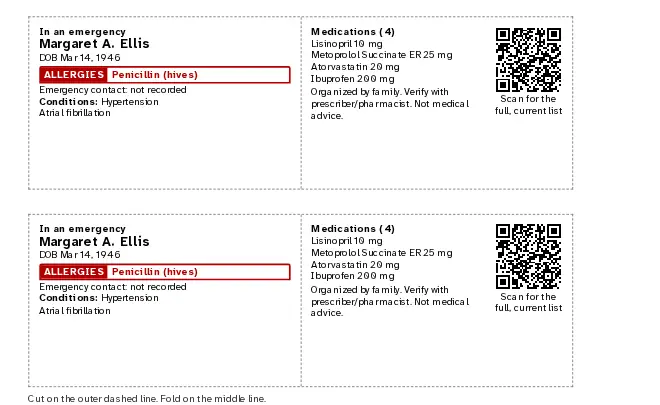
A simple wallet card template
You can copy this layout onto an index card cut to wallet size (about 3.4 × 2.1 inches, a standard business card), or fold a half sheet of paper in quarters.
Front
- MEDICAL INFORMATION – Name: ______ DOB: ______
- Conditions: ______
- Allergies: ______
- Key medications: ______ (full list: ______)
Back
- In case of emergency call: ______ (relationship) ______ (mobile)
- Second contact: ______
- Doctor: ______ (phone) ______
- Documents (healthcare proxy / POLST): ______
- Updated: ______
Tips that make it last:
- Print or write in dark ink, no smaller than you can read without glasses.
- Laminate it, or put it in a plastic sleeve, so it survives the wallet.
- Make two: one in the wallet behind the ID, one in the car's glove box.
- Put a sticker or note on the front of the wallet: "Medical info inside."
If you want a full page for home as well, our free one-page ER sheet has room for the complete medication list, doctors and insurance, in US Letter and A4.
Put the same information on your parent's phone
Paramedics and ER staff often check a patient's phone. Both major phone systems can show medical information without the passcode:
- iPhone: in the Health app, set up Medical ID. It can include medications, allergies, conditions and emergency contacts. Turn on Show When Locked so it can be read from the lock screen, and Share During Emergency Call so it can be shared with emergency services where that is available (Apple Support).
- Android: in the Safety app (or Settings on some phones), open Your info to add medical information and emergency contacts. Anyone can view it from the lock screen by swiping up, tapping Emergency, then View emergency info (Google Android Help). Some steps need Android 12 or later.
Set it up together with your parent, on their phone, so they know it is there and agree to what it shows.
Keep it current
A medical ID card is only useful if it matches reality. Update it:
- After every hospital stay or ER visit. Discharge often changes medications.
- When a dose, medication or doctor changes.
- When an emergency contact changes phone number or moves away.
- On a regular check, for example every three months.
When you update the card, update the phone and the fridge copy the same day. Three versions that disagree cause more confusion than one.
How siblings can share one version
If several of you help, decide who owns the card and where the master copy lives. A shared document or a tool that keeps one current version means nobody prints a card from an old list. Whoever goes with your parent to the ER should also know what to bring to the ER.
ParentFile turns photos of the pill bottles, insurance cards and discharge papers into a one-page ER sheet, wallet cards and a medication list that siblings can open through a view-only link. You confirm every item before anything is printed. See what's in the ParentFile kit.
Frequently asked questions
- What should be on a medical ID card?
- Your parent's full name and date of birth, the conditions a responder must know about, current medications or where the full list is, allergies, one or two emergency contacts, their primary doctor, and where to find documents such as a healthcare proxy or POLST.
- Is a medical ID card the same as a medical alert bracelet?
- No. A bracelet or necklace is engraved with a few critical facts and is worn on the body. A wallet card holds more detail on paper. Many families use both, plus the medical ID on the phone.
- Should the full medication list go on the wallet card?
- Only if it fits and stays readable. A short list of medications is fine. For a longer list, write the most important ones and add "Full medication list: on the fridge and in the phone," then keep that list current.
- How often should the card be updated?
- Whenever a medication, dose, doctor or contact changes, and after every hospital stay. A quick check every three months catches the changes nobody wrote down.
- Can paramedics see the medical ID on a locked phone?
- Yes, if it is set up. On an iPhone, the Medical ID in the Health app can be shown on the lock screen. On Android, emergency information can be viewed from the lock screen via Emergency, then View emergency info.
Sources
- Set up your Medical ID in the Health app on your iPhone, Apple Support
- Get help during an emergency with your Android phone, Google Android Help
- Older Adults: Prepare for Emergencies (flyer), Ready.gov / FEMA
Sources checked on October 27, 2026. If you spot something out of date, email support@getparentfile.com.
Not medical or legal advice. ParentFile guides help families get organized. They don't replace a doctor, pharmacist, nurse or lawyer. In an emergency, call 911 (US) or 999 (UK).