Aging parents checklist: 25 things to have in place
By the ParentFile team · Updated · 9 min read
The short answer
An aging parents checklist covers six areas: health information (medications, allergies, doctors, insurance), legal papers (healthcare power of attorney, advance directive, HIPAA release, a POLST or DNR if it fits), money and benefits, home safety and falls, driving, and who in the family does what. Start while your parent is well and can make their own decisions, because many legal papers can only be signed by them while they are able to decide. Work through it together, one section at a time, write down where each signed original is kept, and review it every year and after any hospital stay, fall or medication change.
Most families start this list in a waiting room, after a fall or a phone call from a hospital. It is much easier to do it earlier, while your parent is well and can make every decision themselves. This aging parents checklist covers 25 things in six areas. You don't need to finish it in a weekend. Pick one section, talk it through with your parent, and tick items off over a few weeks.
The best version of this checklist is one you fill in with your parent, not about them.
1. Health information (items 1–6)
When something goes wrong, the first questions from a paramedic or ER nurse are always the same: what medicines, what allergies, what conditions, who is the doctor. Have the answers written down in one place.
- A current medication list. Every prescription, over-the-counter medicine, vitamin and supplement, with the dose and when it's taken. Our guide to a medication list for an elderly parent shows what to include.
- Allergies and major conditions, written in plain words, plus past surgeries and any implanted devices such as a pacemaker.
- Doctors and pharmacies: names, phone numbers, and which hospital your parent prefers.
- Insurance details: Medicare number, any Medicare Advantage, Medigap or Part D plan, and any other coverage. Keep photos or copies of the cards.
- A yearly wellness visit on the calendar. Medicare covers a yearly "Wellness" visit once every 12 months. Medicare.gov says it includes a review of current prescriptions, a cognitive assessment, and an offer to talk about advance directives. It is a good moment to update everything in this section.
- A one-page summary that travels. One sheet with the essentials, kept at home and in a bag for the ER. Our free one-page ER sheet is built for exactly this, and our guide on what to bring to the ER covers the rest of the bag.
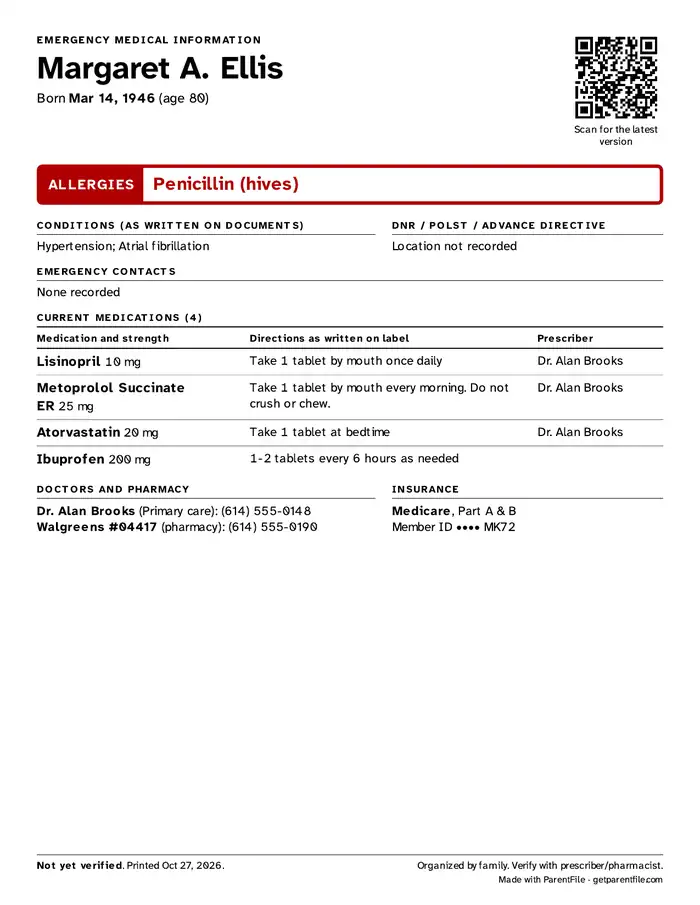
If your parent's records are spread across several doctors and portals, start with our guide on how to organize your parent's medical information.
2. Legal papers (items 7–11)
Many of these can only be signed by your parent while they are able to make their own decisions. That is the main reason not to wait.
- Healthcare power of attorney (also called a health care proxy or agent). It names who makes medical decisions if your parent can't.
- An advance directive / living will that records your parent's wishes about future care.
- A HIPAA release so doctors can talk to you. Our HIPAA release form guide explains who signs it and what it covers. For Medicare itself, there is a separate form: CMS-10106, which lets 1-800-MEDICARE share your parent's information with you.
- A POLST or DNR, if it fits your parent's health. These are medical orders for people who are seriously ill or frail, signed with a clinician. See POLST vs DNR for the difference.
- Financial power of attorney and a will (or trust), made with an attorney in your parent's state.
For each one, write down where the signed original is and who has a copy. The National Institute on Aging publishes a "Getting Your Affairs in Order" checklist that is a useful companion to this list, and our guide to important documents for aging parents goes through the core set.
3. Money and benefits (items 12–16)
- A list of accounts: banks, retirement accounts, pensions, insurance policies, and who to call for each. You don't need passwords on this list. You need to know the accounts exist.
- Regular bills and how they're paid (automatic payments, checks, online), so nothing lapses during a hospital stay.
- Social Security and other benefits. One detail surprises many families: the Social Security Administration says a power of attorney does not usually give someone the right to manage a person's Social Security benefits. If your parent can no longer manage them, a family member would need to apply to become their representative payee.
- A realistic talk about long-term care costs. Medicare.gov is direct about this: Medicare doesn't pay for long-term care when it's mostly non-medical help (bathing, dressing, eating). Depending on the state, Medicaid may cover it, and some people have private long-term care insurance. Knowing this early changes the options.
- A yearly insurance check. Medicare Open Enrollment runs October 15 to December 7 each year. During it, your parent can switch between Original Medicare and Medicare Advantage, or change drug plans, and changes start January 1. If their medications changed this year, it's worth checking the plan still covers them.
4. Home safety and falls (items 17–20)
The CDC reports that more than one in four older people fall each year, and fewer than half tell their doctor.
- A walk-through of the home: loose rugs, poor lighting on stairs, clutter on walkways, and things stored too high.
- Bathroom safety: grab bars, a non-slip mat, a shower seat if needed.
- A way to call for help, such as a phone your parent can reach from the floor, or a medical alert device if they want one.
- Emergency information where responders can find it, for example on the fridge, plus a medical ID wallet card your parent carries.
5. Driving and getting around (items 21–22)
- An honest look at driving. The National Highway Traffic Safety Administration lists warning signs such as missing stop signs or red lights, drifting between lanes, and getting lost on familiar routes. NHTSA says no single sign proves someone is unsafe, but several together are a reason to act. Its advice: ride along over time, keep dated notes, and talk with compassion using "I am concerned" language.
- A transport plan B: who drives to appointments, local senior transport, delivery for groceries and prescriptions, so giving up the car (if it comes to that) doesn't mean giving up independence.
6. Family roles and support (items 23–25)
- Who does what. One person for appointments, one for bills, one for weekly calls. Write it down so it doesn't all fall on whoever lives closest. Our guide on sharing parent care with siblings has a simple way to split it.
- Local help. The Eldercare Locator (1-800-677-1116, call or text), run by the federal Administration for Community Living, connects families to local services such as the Area Agency on Aging.
- A review date. Put a yearly review on the calendar, and also review after any hospital stay, fall, new diagnosis, medication change or move.
Printable aging parents checklist
Health information
- 1. Current medication list (with doses and supplements)
- 2. Allergies, conditions, surgeries, implanted devices
- 3. Doctors, pharmacies, preferred hospital
- 4. Insurance numbers and copies of cards
- 5. Yearly wellness visit booked
- 6. One-page ER sheet printed and in the ER bag
Legal papers (note where each original is kept)
- 7. Healthcare power of attorney
- 8. Advance directive / living will
- 9. HIPAA release (and CMS-10106 for Medicare)
- 10. POLST or DNR, if it fits your parent's health
- 11. Financial power of attorney and will or trust
Money and benefits
- 12. List of accounts and who to call
- 13. Regular bills and how they're paid
- 14. Social Security: is a representative payee needed?
- 15. Long-term care costs discussed
- 16. Medicare plan checked during Open Enrollment (Oct 15 – Dec 7)
Home safety
- 17. Home walk-through for fall risks
- 18. Bathroom grab bars and non-slip mat
- 19. A way to call for help
- 20. Emergency info on the fridge and a wallet card
Driving
- 21. Driving discussed honestly
- 22. Transport plan B
Family
- 23. Who does what, written down
- 24. Local help found (Eldercare Locator 1-800-677-1116)
- 25. Next review date set
Where ParentFile fits
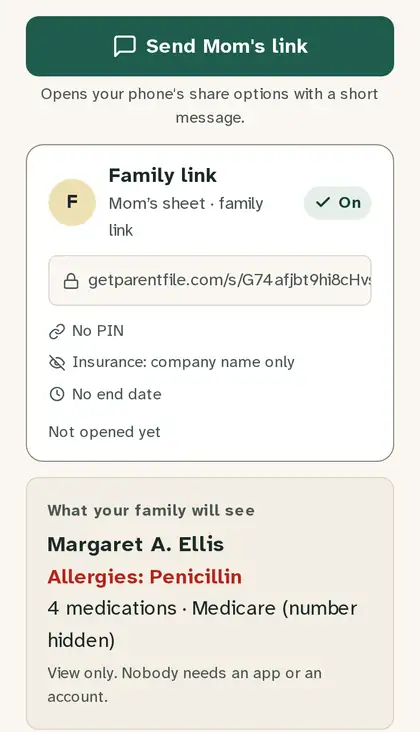
ParentFile is an organization tool for the health part of this list (items 1–4, 6 and the "where is it kept" notes for items 7–10). You photograph your parent's pill bottles and confirm each item, record allergies, conditions, doctors and insurance, and mark which documents exist and where the originals are. From that it prints a one-page ER sheet and wallet cards, and siblings can get a view-only link. It doesn't give medical, legal or financial advice, doesn't store document scans, and doesn't handle money, bills or benefits.
Frequently asked questions
- What should be on an aging parents checklist?
- Six areas: health information (medications, allergies, doctors, insurance), legal papers (healthcare power of attorney, advance directive, HIPAA release), money (accounts, bills, benefits), home safety and falls, driving and getting around, and a plan for who in the family does what.
- When should I start an aging parents checklist?
- Before a crisis. The calmest time is while your parent is well and can make their own decisions, because many legal papers can only be signed by your parent while they are able to decide. A hospital stay, a fall or a new diagnosis is a reminder to finish it.
- Does a power of attorney let me manage my parent's Social Security?
- Not by itself. The Social Security Administration says a power of attorney does not usually give someone the right to manage a person's Social Security benefits. If your parent can no longer manage them, you would need to apply to become their representative payee.
- Does Medicare pay for long-term care for an elderly parent?
- Generally no. Medicare.gov says Medicare doesn't pay for long-term care when it is mostly non-medical help, such as help with bathing, dressing or eating. Depending on the state, Medicaid may cover it, and some people have private long-term care insurance.
- How often should we review the checklist?
- At least once a year, and after any hospital stay, fall, new diagnosis, medication change or move. Medicare's fall Open Enrollment (October 15 to December 7) is a natural yearly moment to review insurance and medications too.
Sources
- Older Adult Falls Data / Facts About Falls, Centers for Disease Control and Prevention (CDC)
- Long-term care coverage, Medicare.gov (CMS)
- Open Enrollment, Medicare.gov (CMS)
- Yearly Wellness visits, Medicare.gov (CMS)
- CMS-10106: 1-800-MEDICARE Authorization to Disclose Personal Health Information, Centers for Medicare & Medicaid Services
- Frequently Asked Questions for Representative Payees, Social Security Administration
- Eldercare Locator, Administration for Community Living (HHS)
- How to Understand and Influence Older Drivers, National Highway Traffic Safety Administration (NHTSA)
Sources checked on October 31, 2026. If you spot something out of date, email support@getparentfile.com.
Not medical or legal advice. ParentFile guides help families get organized. They don't replace a doctor, pharmacist, nurse or lawyer. In an emergency, call 911 (US) or 999 (UK).